
A door has more parts than most homeowners realize, and understanding what each one does becomes useful the moment something stops working or you start thinking about a door replacement.
A standard residential door is made up of 15 distinct components, grouped into the frame, the door slab itself, and the hardware. Each part has a specific job, and knowing the names helps when talking to a contractor or shopping for parts.

Quick Reference: All 15 Parts of a Door
| Part | Location | Primary Function |
| Door Header | Top of frame | Supports wall load |
| Side Jambs | Sides of frame | Holds door in place |
| Door Sill | Bottom of frame | Weatherproof seal |
| Door Sweep | Bottom of slab | Bottom seal |
| Weather Stripping | Frame perimeter | Side and top seal |
| Top Rail | Top of slab | Structural support |
| Bottom Rail | Bottom of slab | Structural support |
| Mid Rail | Center of slab | Panel separation |
| Lock Stile | Lock side of slab | Holds locking hardware |
| Hinge Stile | Hinge side of slab | Holds hinges |
| Door Panels | Between rails/stiles | Visual + light |
| Door Hinges | Hinge stile | Allows swing |
| Handle/Lock Set | Lock stile | Operates door |
| Strike Plate | Side jamb | Receives latch |
| Door Latch | Lock stile | Holds door closed |
Here’s the full breakdown of every part, what it does, and why it matters.
The Frame: Where the Door Sits
The frame is the structural opening the door sits inside. It does the work of supporting the door, holding it square, and creating the seal that keeps weather out.
1. Door Header
The horizontal beam at the top of the door opening, also called the head jamb. It supports the wall above the door and bears the load that would otherwise crush the door frame. Without a properly sized header, doors stick, settle, and eventually fail to close.
2. Side Jambs
The vertical components on either side of the door frame the opening from top to bottom. The side jambs hold the hinges on one side and the strike plates on the other. They’re what your door swings against when it closes.
3. Door Sill
The horizontal piece at the bottom of an exterior door frame is sometimes called the threshold. The door sill creates the weatherproof seal at the bottom of the door and is sloped slightly to channel water away from the interior. Interior doors typically don’t have sills.
4. Door Sweep
A strip of flexible material attached to the bottom edge of an exterior door that creates the seal between the door slab and the door sill. The door sweep blocks drafts, water, and pests. When a door starts feeling drafty at the floor, the sweep is usually the culprit.
5. Weather Stripping
The flexible seal that runs along the side jambs and head jamb of an exterior door frame. Weather stripping closes the small gaps between the door slab and the frame, dramatically improving energy efficiency. The Department of Energy’s home weatherization guidance notes that worn weather stripping is one of the most common sources of household energy loss, and replacing it is one of the highest-return small home improvements available.
The Door Slab: The Part That Swings

The door slab is what most people mean when they say “the door.” It’s the panel that swings open and closed, and it has its own internal anatomy.
6. Top Rail
The horizontal component at the top of the door slab. Along with the bottom rail, the top rail provides the structural frame of the door itself.
7. Bottom Rail
The horizontal piece at the bottom of the door slab. The bottom rail is typically wider than the top rail and gives the door its strength at the bottom edge, where it sees the most physical wear.
8. Mid Rail
The horizontal component in the middle of paneled doors, separating the upper and lower panels. Not all doors have a mid rail. Single-panel doors and flush doors lack this component entirely.
9. Lock Stile
The vertical component on the side of the door where the locking mechanism is installed. The lock stile is bored with the bore hole for the door handles, deadbolt, and any additional locking mechanisms.
10. Hinge Stile
The vertical component on the opposite side of the door where the hinges mount. The hinge stile carries the entire weight of the door and bears the most stress over the door’s lifetime. Most exterior doors have three hinges mounted to this stile, while interior doors typically have two.
11. Door Panels
The recessed flat areas between the rails and stiles. Panels can be smaller decorative elements or larger glass panes that let light through. The number and arrangement of panels defines the visual style of the door: traditional six-panel doors, modern flush doors, or French doors with glass panels throughout.
The Hardware: How the Door Operates
The hardware is what makes a door functional. These components handle the swinging, locking, and operation of the door.
12. Door Hinges
The metal mechanisms that connect the door slab to the hinge stile allow the door to swing open and closed. Standard residential doors use three hinges (or two for interior doors), distributed along the height of the door to distribute weight evenly. The International Code Council’s building safety resources outline hinge requirements for residential applications, especially for exterior doors and fire-rated doors.
13. Door Handle and Lock Set
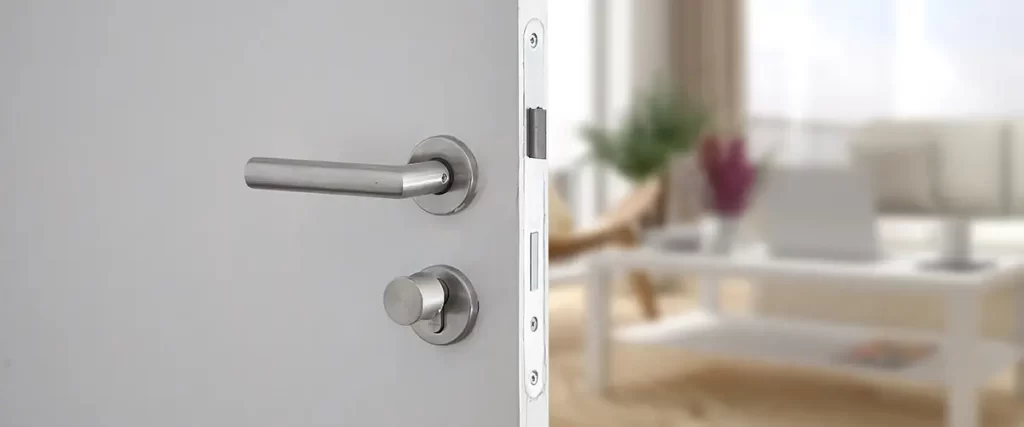
The mechanism mounted into the bore hole of the lock stile that operates the door’s latch and locking system. This includes the door handles on both sides, the key cylinder for exterior locks, and the thumb turn typically found on the interior side. Modern lock sets often combine the handle and deadbolt into one integrated unit.
14. Strike Plate
The metal plate mounted to the side jamb that the door latch engages when the door closes. The strike plate takes the force of the door slamming and is the most common failure point during forced entry attempts. Upgraded strike plates with longer screws into the wall framing dramatically improve security.
15. Door Latch
The spring-loaded mechanism that holds the door closed when the handle is released. The door latch extends into the strike plate, securing the door against the frame. When a door won’t stay closed or pops open under wind pressure, the latch or strike plate alignment is usually the issue.
Common Questions About Door Anatomy
Why does it matter to know the parts of a door?
It helps with repairs, replacement decisions, and conversations with contractors. Knowing that the drafty bottom of your door is the door sweep (not the whole door) means you might save thousands on an unnecessary replacement.
What’s the difference between a door slab and a pre-hung door?
A door slab is just the door panel itself. A pre-hung door includes the slab, the frame (jambs and header), and the hardware already installed. Pre-hung doors are easier to install on a new opening.
Can I replace just one part of a door?
Yes, depending on which part. Hardware (hinges, handles, strike plates), weather stripping, door sweeps, and individual panes of glass are commonly replaced without changing the whole door. Structural components like the jambs or rails typically come with full replacement.
What part of a door wears out first?
Usually the weather stripping and door sweep on exterior doors, since they handle the most physical wear and weather exposure. Hinges and lock sets typically last decades with normal use.
Are exterior doors built differently than interior doors?
Yes. Exterior doors have weather stripping, a door sill, a door sweep, and are typically thicker and more insulated than interior doors. Not all exterior doors include every component the same way, but the core anatomy is consistent.
When the Anatomy Lesson Points to Replacement
Knowing every part of a door is useful right up until you realize the door itself is past the point of fixing component by component. If multiple parts are failing at once, the frame is warped, or energy loss through the door is meaningfully affecting your utility bills, full replacement usually makes more sense than chasing individual repairs.
Call us at (402) 651-1493 or message us here to talk through door replacement options. Our door replacement service page has more on what we install.